Channels and Substrates: Distributed Cognition as an Interaction Model for Ubiquitous Analytics
Abstract
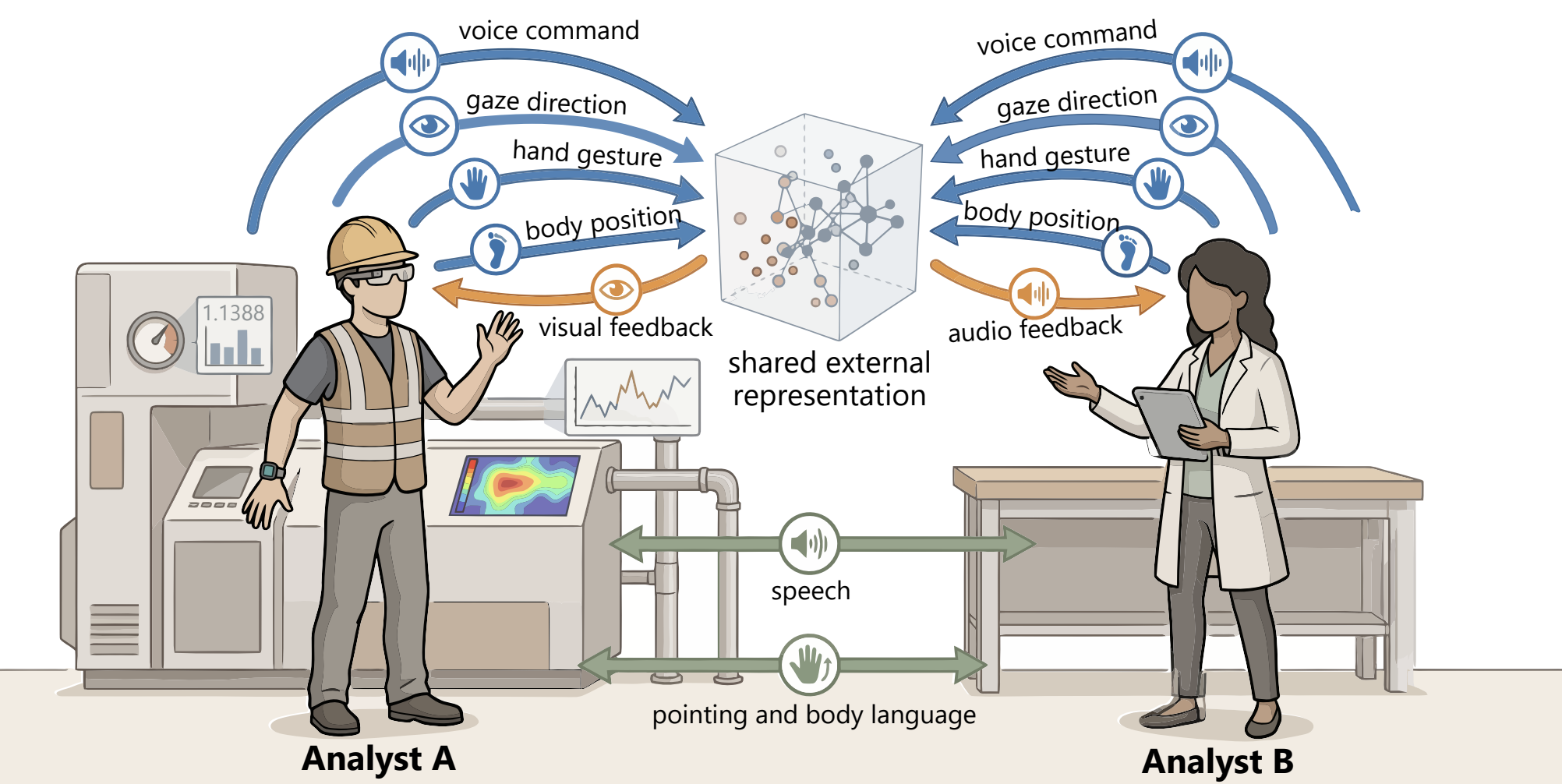
Traditional HCI interaction models assume a single monolithic interface and a stable sensorimotor loop. These models fit poorly with cross-device (XVA) and ubiquitous analytics (UA), where interactive data sensemaking unfolds across multiple devices, artifacts, and people in disparate settings from the office to the factory floor. In this paper, we show how interaction in ubiquitous analytics can be modeled using distributed cognition as propagation of representational state across substrates – minds, speech, bodies, artifacts, and devices – rather than as traffic through a single interface. On this basis we introduce input and output channels as generalizations of the visual channels from data visualization: just as visual channels carry data through properties of the visual substrate, input and output channels carry representational state through substrates whose availability, suitability, and preferability depend on context. We demonstrate the channels and substrates framework by reanalyzing several ubiquitous, immersive, and situated analytics systems.
N. Elmqvist, P. D. Ritsos, and P. W. S. Butcher, “Channels and Substrates: Distributed Cognition as an Interaction Model for Ubiquitous Analytics.” 2026.
[Online] Available at: arXiv:2606.11986
Bibtex
@misc{elmqvist2026channels,
  title = {Channels and Substrates: Distributed Cognition as an Interaction Model for Ubiquitous Analytics},
  author = {Elmqvist, Niklas and Ritsos, Panagiotis D. and Butcher, Peter W. S.},
  year = {2026},
  eprint = {2606.11986},
  archiveprefix = {arXiv},
  primaryclass = {cs.HC}
}