Paper accepted in Computer Graphics Forum
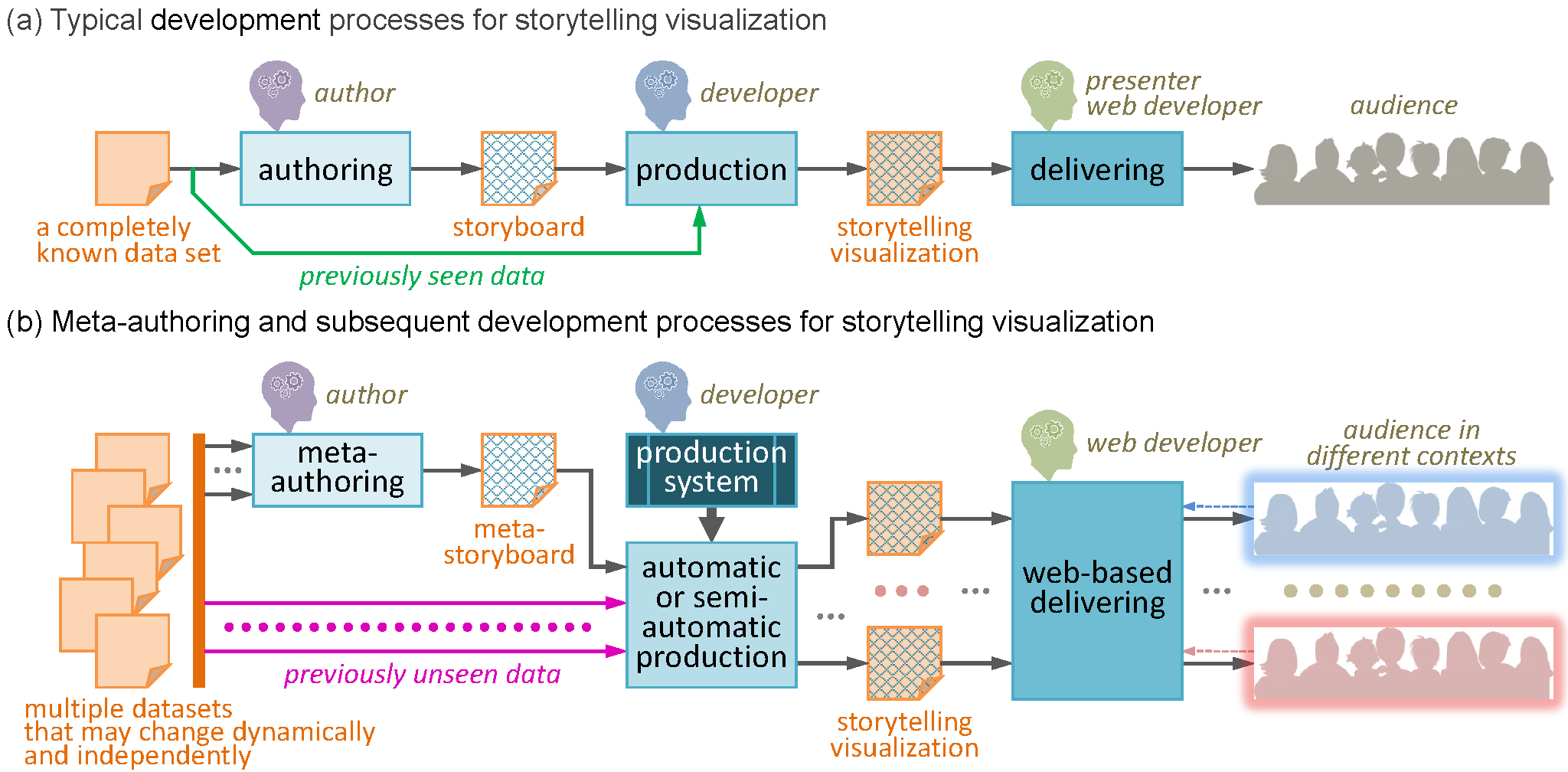
Our paper “Meta-Storyboard Using Feature-Action Patterns - Concept, Techniques, and Case Studies” has been accepted in Computer Graphics Forum.
This paper introduces the concept of the meta-storyboard (MSB) and a corresponding approach to meta-storyboard authoring for data-driven storytelling. Conventionally, a storyboard is fixed in advance for a specific dataset and the message an author wishes to convey. Such a static approach cannot accommodate changing data, nor can it scale to the demand for visual stories tailored to different viewers and contexts. With a meta-storyboard, the author instead anticipates features that may emerge in incoming or user-selected data, and specifies visualization actions that explain those features. An MSB therefore consists of feature-action patterns: reusable design patterns tied to anticipated data features, viewer requests, and application contexts. We developed the MSB concept through two case studies - one on Pandemic data streams, and one on data streams produced for machine learning benchmarks.
Reference
S. Khan, S. Jones, B. Bach, J. Cha, M. Chen, J. Meikle, J. C. Roberts, J. Thiyagalingam, J. Wood, and P. D. Ritsos, “Meta-Storyboard Using Feature-Action Patterns: Concept, Techniques, and Case Studies,” Computer Graphics Forum (to appear), 2026.
This paper introduces the concepts of meta-storyboard (MSB) and meta-storyboard authoring for data-driven storytelling. Traditionally, in data-driven storytelling, a storyboard is predefined for a given data set and the information an author wants to convey. However, such a static process does not account for dynamic data and does not scale up to the need to produce visual stories for different individual viewers and contexts. In a meta-storyboard, an author anticipates potential features that may appear in dynamically arriving or selected data and consequently defines visualization actions to convey explanations about these features. An MSB thus includes feature-action patterns as reusable design patterns for anticipated data features, viewers’ requests, and application contexts. Through two case studies, we first developed the concept of MSB as a standalone software for communicating time series data in the context of COVID-19; then, we broadened the concept as an API to tell stories about machine learning workflows. MSB is complementary to traditional methods for authoring storytelling visualizations, while
providing an efficient means to construct data-dependent storyboards for different data streams of similar contexts
[Abstract]
[Details]
[PDF]
[Preprint]